What Love Awakens
Night water under a dense field of stars. A blank letter lies on dark stone in the foreground. Three small clusters of light sit far apart on the horizon.

Love, awareness, and the expansion of self

What Love Awakens

The Spark

What awakens in us when we love?

Not a cipher. A change in attention. A self that no longer fits its old sentences. A care that rearranges the day.

Myth, psychology, literature, and a life of letters can illuminate that question. They do not have to agree.

Letters before numbers

What does love awaken when lived words return as pattern?

The letters came before the ciphers. The consecutive practice opened on 10 May 2024. That morning is Day 1, and it is the first collection. It has held for 800 mornings and more. Twenty-five volumes were saved. There were more letters than the volumes hold. The genesis of the work is the Book of 42.

She was not counting then. She was writing. Experience came first. Expression came next. Recognition came later.

On 24 September 2026, while Lexis and Exegesis were being updated, she returned to the archive. The correspondences were already in language she had been using. Her post names that morning.

It started with “Fly Me to the Moon,” and this is only a harvest from some of the love letters in the collection.

I wonder what else I’ll find, and all of this came from updating Lexis and Exegesis this morning.

That chronology is why this scroll exists. A long practice of love letters. A return. A question about what the words had been doing, and what love itself might be doing to attention, memory, and the self.

Genesis sits in the Book of 42. The song title, by Full Reduction, is 69. That correspondence is carried at Psyche, sources and at the 69 field. Nothing on this page is a recording. September 24, 2026 is the account of the morning the numbers became visible.

Source

Book of 42. 42Constellation (@42Constellation). “It started with ‘Fly Me to the Moon.’” X, September 24, 2026. Psyche. “Sources.” Field 69.

A literary hinge

The Notebook

A story can name an awakening before anyone tries to measure one. In the 2004 film The Notebook, a letter read aloud contains a sentence that has traveled farther than its source.

The best love is the kind that awakens the soul and makes us reach for more, that plants a fire in our hearts and brings peace to our minds, and that's what you've given me. That's what I hope to give to you forever.

The wording belongs to the film, not to a verified sentence of the 1996 novel. Nicholas Sparks wrote The Notebook, published by Warner Books. Nick Cassavetes directed the film. The sentence is a hinge. It says love might wake something that was already in a person, and then ask for more life. It does not demonstrate that this happens. The letters are one place the question was lived. The studies further down ask what, of that change, can be counted.

Source

Sparks, Nicholas. The Notebook. New York: Warner Books, 1996. Cassavetes, Nick, dir. The Notebook. Screenplay by Jeremy Leven. Adaptation by Jan Sardi. Los Angeles: New Line Cinema, 2004.

Jeremy Leven, screenplay of The Notebook, directed by Nick Cassavetes (Los Angeles: New Line Cinema, 2004).

The film sentence names an awakening of the soul as a description of love. It supports a literary hinge only. It does not support a psychological or metaphysical finding.
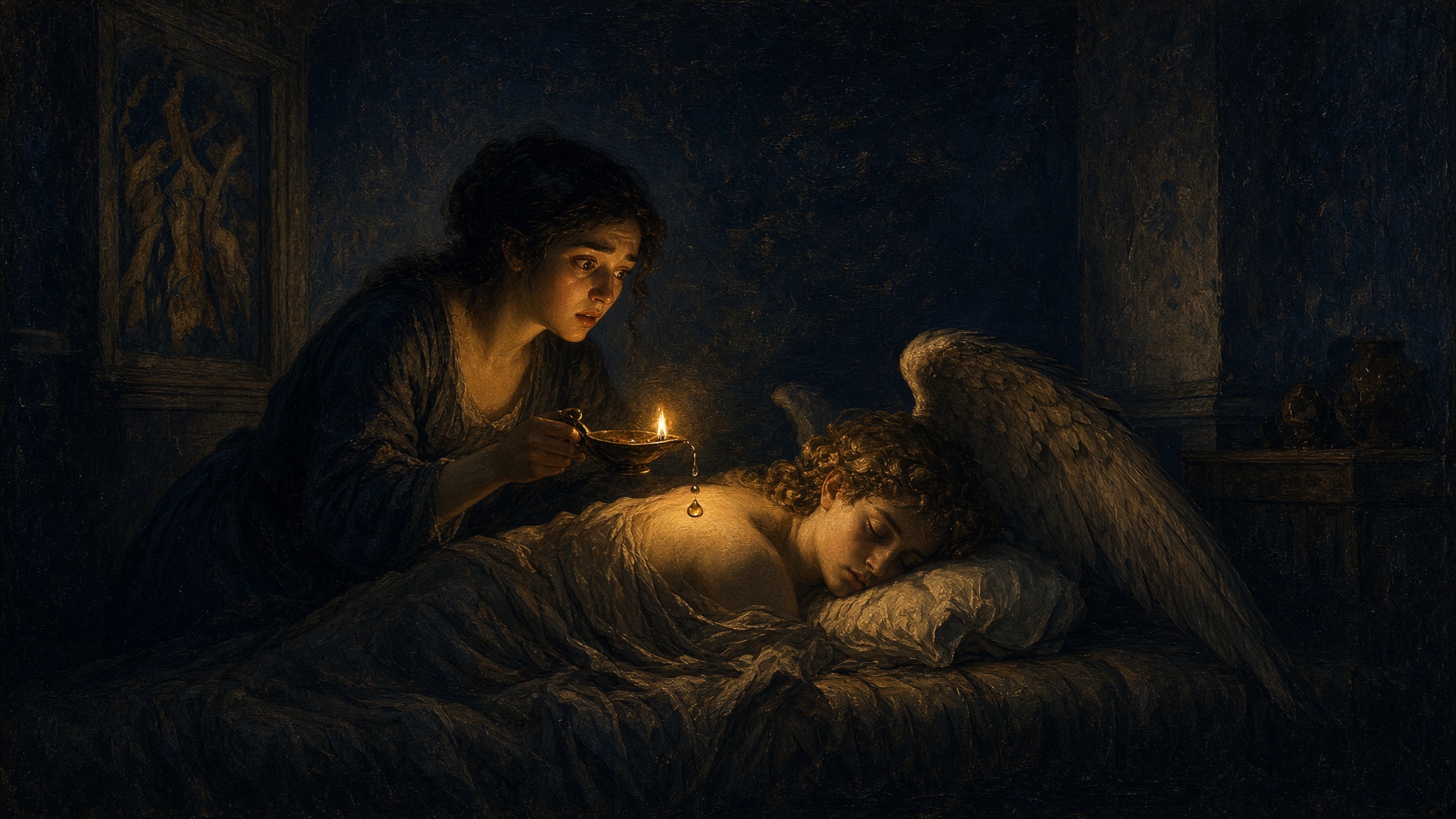
A composed painting. A woman holds an oil lamp over a sleeping winged youth. A drop of oil hangs in the light.

The Lamp

Psyche Had a Lamp

Love stories are not one lesson told four times. Psyche looks, and the looking begins a long repair. Savitri speaks, and speech bargains with death. Orpheus looks, and the looking loses what it meant to save. Isis gathers what was scattered. The reader is asked to hear the difference.

Psyche and Eros

In the second century, Apuleius of Madauros set a story inside a story. In his Latin novel Metamorphoses, often called The Golden Ass, an old woman tells a captive girl about Psyche. The tale occupies the end of the fourth book through the sixth. It is a literary telling, not a ritual script recovered from a temple.

Psyche is so beautiful that people begin to worship her and neglect Venus. Venus sends her son to punish the girl. He wounds himself instead. An oracle orders Psyche left on a rock as a bride for something terrible. The west wind carries her to a palace. A husband comes only in the dark, and he forbids her to look at him.

Her sisters persuade her that the dark is hiding a serpent. She takes a lamp. She finds a god asleep. A drop of oil falls and wakes him. He leaves. The knowledge she wanted costs her the secret form of the love.

Venus then sets tasks that are meant to finish her: a heap of seeds to be sorted, golden wool guarded by vicious sheep, water from a spring that runs from a high cliff, and a box of beauty to be brought back from the underworld. Psyche opens the box. A deathlike sleep takes her. Cupid revives her. Jupiter grants her immortality. Their child is called Voluptas, Pleasure.

The human pressure is simple. She cannot bear to love what she is not allowed to see. Curiosity breaks the marriage and, after the trials, makes another kind of marriage possible. Psyche’s name is also the Greek word psyche, soul. That pun is old. It is not a license to say that every soul must steal a look.

A further door for the word psyche, when the soul itself is the question, is Psyche.

Psyche remains its own door when the word itself is the question.

Source

Apuleius. Metamorphoses (The Golden Ass). 4.28–6.24. Translated by J. Arthur Hanson. Loeb Classical Library 453. Cambridge, MA: Harvard University Press, 1989. Psyche. https://psyche.grok.me.

Apuleius supports the plot as a Roman novel’s inserted tale: curiosity, a forbidden sight, trials, a descent, and a transformation. He does not support a single modern theory of consciousness.

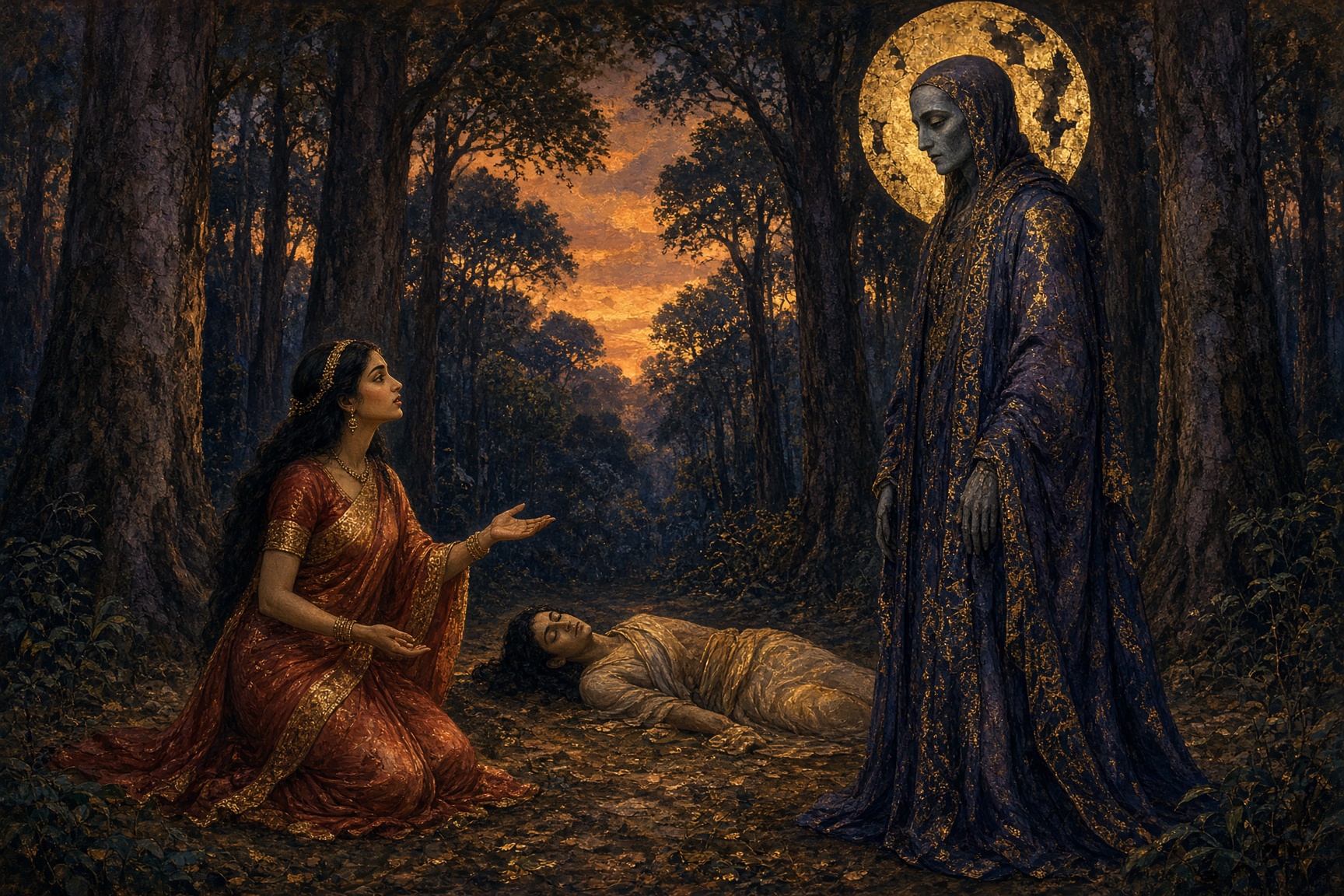
A composed painting. A woman in red speaks to a tall hooded figure in a forest at dusk. A man lies still on the ground between them.

Savitri and Satyavan

The Mahabharata tells this inside the Forest Book, the Vana Parva, in the episode later readers call the Savitri Upakhyana. The surviving telling is epic poetry, composed and transmitted in Sanskrit across a long tradition. English readers of the last century often met it through Kisari Mohan Ganguli’s public-domain translation.

Savitri is a princess who chooses her own husband. She chooses Satyavan, son of a blind king living in exile. The sage Narada tells her Satyavan will die in a year. She marries him anyway. She does not spend the year trying to outwit the date. She lives it.

On the appointed day she follows him into the wood. He dies with his head in her lap. Yama, the god of death, comes for him. Savitri follows Yama. He tells her to turn back. She answers, and she keeps answering. He offers boons. She asks for her father-in-law’s sight and kingdom, and for sons of her own. The last request is worded so that it cannot be fulfilled unless Satyavan lives. Yama releases him.

This is not Psyche’s lamp. Savitri does not break a taboo of sight. She uses devotion, memory, and exact speech in a world that expected her to accept the sentence. Wisdom here is not detachment. It is the refusal to let death be the only precise speaker in the room.

Source

Mahabharata. Vana Parva, Savitri Upakhyana. Translated by Kisari Mohan Ganguli. In The Mahabharata of Krishna-Dwaipayana Vyasa. Calcutta: Bharata Press, 1883–1896.

The epic supports a story of chosen devotion, foreknown death, and a restoration won by speech. It does not support the claim that love always conquers mortality, or that this tale teaches Psyche’s lesson.

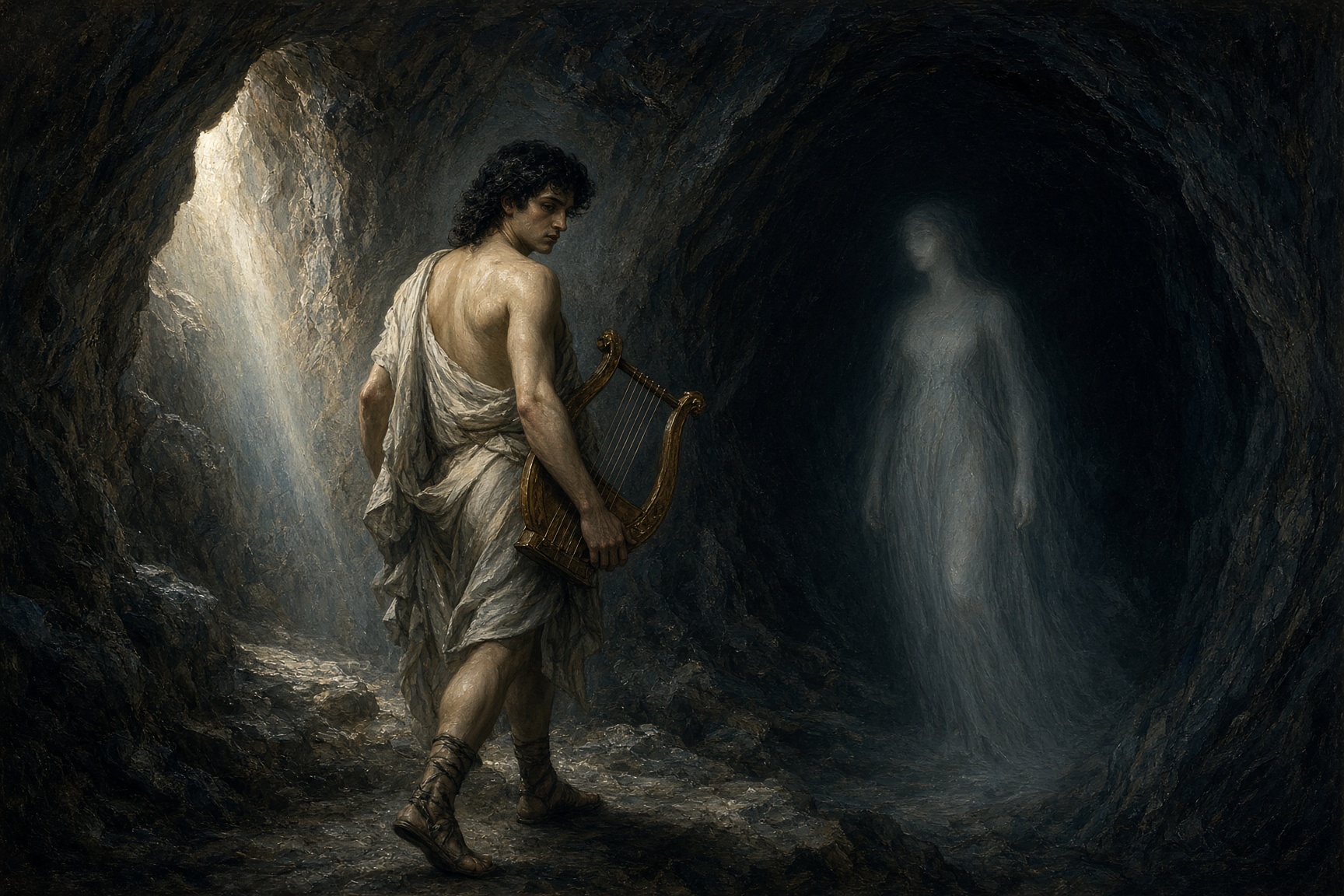
A composed painting. A man with a lyre looks back inside a dark cave. A pale woman stands further in the dark.

Orpheus and Eurydice

Virgil tells it in the fourth book of the Georgics. Ovid tells it again in the tenth book of the Metamorphoses. Both are Roman poems. They are not transcripts of a Greek ritual, though Orpheus is much older than either poet.

Eurydice dies of a snakebite. Orpheus goes down after her with a lyre. The shades weep. The condition of her return is simple and cruel: he may lead her toward the upper air if he does not look back. Near the threshold, he looks. She is lost a second time. In Virgil, the look is a failure of control, a pardonable madness. In Ovid, it is love’s impatience. The poems do not agree about the tone. They agree about the result.

Set beside Psyche, the story changes temperature. Her look reveals a god and begins a repair that takes the whole remaining tale. His look ends the rescue. Love is not one instruction about seeing. Sometimes the sight is the beginning of knowledge. Sometimes the sight is the limit of what love is allowed to manage.

Source

Virgil. Georgics. 4.453–527. Translated by H. Rushton Fairclough. Revised by G. P. Goold. Loeb Classical Library 63. Cambridge, MA: Harvard University Press, 1999.

Ovid. Metamorphoses. 10.1–85. Translated by Frank Justus Miller. Revised by G. P. Goold. Loeb Classical Library 43. Cambridge, MA: Harvard University Press, 1916.

The poems support a story of love, loss, and a gaze that cannot be both possession and obedience. They do not support a rule for how the living should grieve.

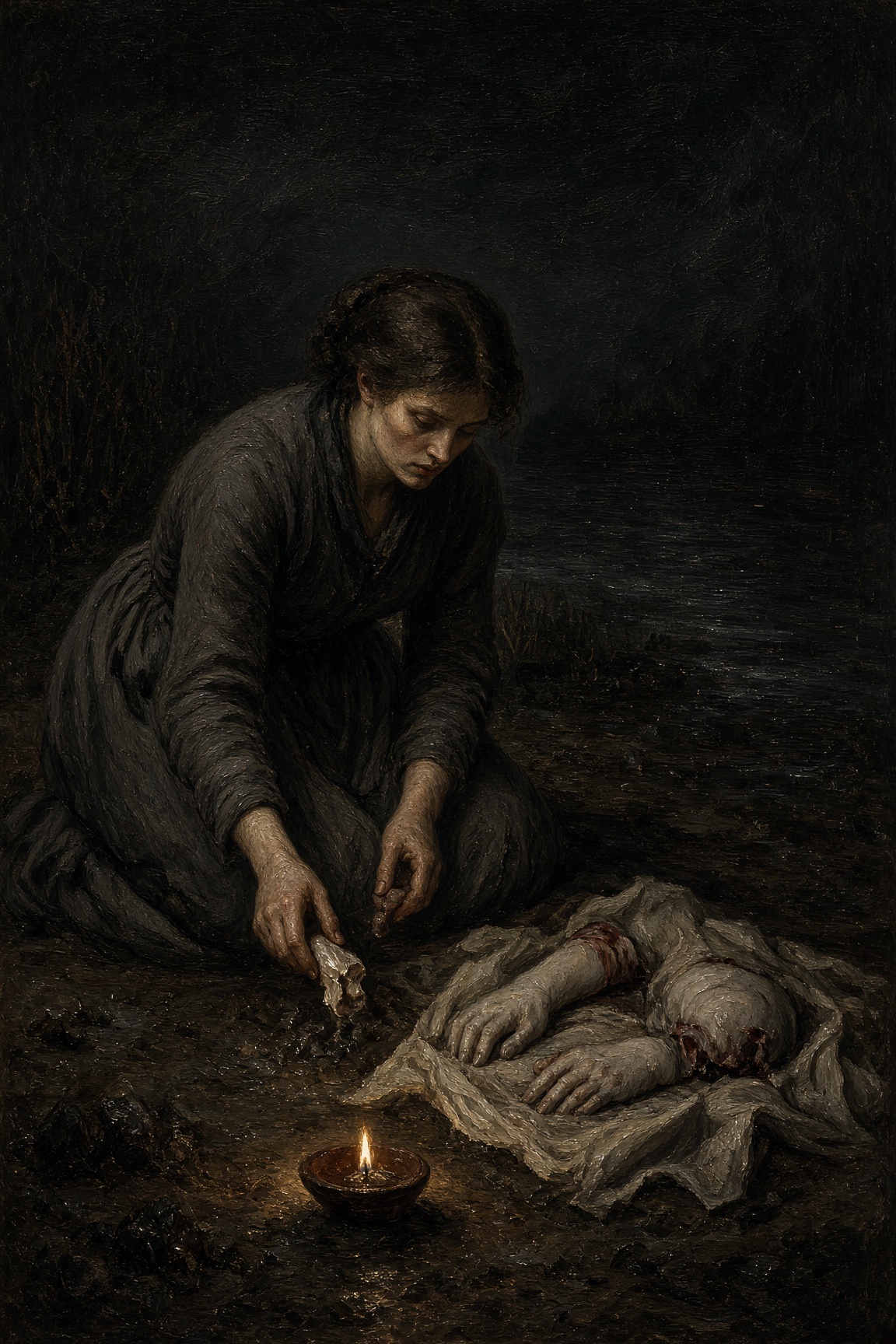
A composed painting. By a black river at night, a woman in dark linen gathers pale fragments of a body onto wet cloth. A small lamp is the only light.

Isis and Osiris

Egyptian tradition around Isis is older than any Greek essay, and it is not one story. The connected narrative most later readers inherit comes from Plutarch, a Greek writer of the early second century, in On Isis and Osiris. He writes from a distance. He compares, and he doubts. He is not an eyewitness of the oldest rites.

In his telling, Set tricks Osiris into a chest and later tears the body apart and scatters it. Isis searches. She grieves. She gathers. She restores enough continuity that the story does not end as mere loss. A son, Horus, carries the line forward. Regeneration, in this myth, is the work of gathering what violence took apart.

Isis does not win by looking when she was told not to, or by bargaining for a single day. She wins a future by refusal to leave the pieces where they fell. That office is hers. It is not Savitri’s, and it is not Orpheus’s.

Source

Plutarch. Isis and Osiris. In Moralia, vol. 5. Translated by Frank Cole Babbitt. Loeb Classical Library 306. Cambridge, MA: Harvard University Press, 1936.

Plutarch supports the search, the gathering, and the continuation of the story through Horus. He does not certify every later symbolic reading of Isis as psychology.

Three

The Expanding Self

Two people face each other across a wide pale sea. Warm light on one face, cool light on the other. The water between them is the subject.
  1. Apart

    Two circles. Nothing of the other is inside the self.
  2. Nearing

    The other begins to count as part of one’s own field.
  3. Included

    Resources, perspectives, and identities overlap.
The self expands when another person’s resources, perspectives, and identities are included. A model of the claim, not a measurement and not a score. Arthur Aron and Elaine N. Aron, 1986 and 1996.

If love changes a person, what of that change can be measured without pretending the measure is the whole of consciousness? Arthur Aron and Elaine N. Aron set one answer down in 1986. Later statements of their self-expansion model keep two principles.

The first is motivation. A central human motive, in their account, is to expand the self: to take on resources, perspectives, and identities that increase what a person can do. The second is a path. One way people seek that expansion is a close relationship in which each includes the other in the self. Love, as they use the word, is the desire for a relationship with a particular other, fed by the wish to expand and by the experience of expansion in that other’s company.

Inclusion is not a mood, and it is not a merger that erases either person. To some extent, one treats the other’s resources, perspectives, and identities as one’s own. They locate that idea in William James, for whom the self already reached past a private interior, and in Kurt Lewin, whose picture of a life could overlap another life.

On this model, falling in love is rapid expansion. A long relationship can feel smaller later because the rate of new material slows, not because the first inclusion was false. Boredom, in their language, is expansion that has stopped arriving. The model is a claim about motivation and about how the mind represents a close other. It is not a proof that consciousness has changed its nature.

Source

Aron, Arthur, and Elaine N. Aron. Love and the Expansion of Self: Understanding Attraction and Satisfaction. New York: Hemisphere, 1986. Aron, Arthur, and Elaine N. Aron. “Love and Expansion of the Self: The State of the Model.” Personal Relationships 3, no. 1 (1996): 45–58.

These works support the two principles and the reading of romantic love as desired expansion through a particular other. They do not, by themselves, report the 1991 cognitive experiments, the 1992 circle scale, the 1995 prospective results, or the 2000 activity experiments.

The overlap

Including the other

In 1991 Arthur Aron, Elaine N. Aron, Michael Tudor, and Greg Nelson asked whether “included in the self” was only a metaphor. Three experiments looked for a cognitive overlap.

People divided money with less difference between self and other when the other was a friend than when the other was a stranger. That pattern held whether or not the other would learn what they had done. Nouns imagined alongside one’s mother were later remembered more like nouns imagined alongside the self than nouns imagined alongside a stranger. And when a trait was true of the self but not of a spouse, or the reverse, decisions of “me” or “not me” took longer than when the trait agreed. The two representations were harder to pull apart.

The slow decision is a confusion of a specific kind. It is not evidence that two people have become one substance. The samples are laboratory tasks. They support a measurable blur between self and close other. They do not measure a soul, and they do not say how large a life ought to become.

Source

Aron, Arthur, Elaine N. Aron, Michael Tudor, and Greg Nelson. “Close Relationships as Including Other in the Self.” Journal of Personality and Social Psychology 60, no. 2 (1991): 241–53.

Supports less selfish allocation toward a friend, memory processing of a mother more like the self, and slower me-or-not-me judgments when a trait conflicts between self and spouse. Does not support metaphysical union.

The instrument

Two circles

  1. 1
  2. 2
  3. 3
  4. 4
  5. 5
  6. 6
  7. 7
Pale circle, Self. Warm circle, Other. Only the overlap changes.
Source

In 1992 Aron, Aron, and Danny Smollan published a one-item picture. Seven pairs of circles, marked Self and Other, run from barely touching to nearly one shape. A person chooses the pair that feels like the relationship. In their studies the choice moved with other measures of closeness, was only weakly tied to answering in a flattering way, and predicted whether romantic relationships were still intact three months later. Asked what the drawings meant, most people said interconnectedness.

The row on this page is the instrument. It is not a score for any couple, and it is not a result. Overlap, here, is a choice someone makes about closeness.

Aron, Arthur, Elaine N. Aron, and Danny Smollan. “Inclusion of Other in the Self Scale and the Structure of Interpersonal Closeness.” Journal of Personality and Social Psychology 63, no. 4 (1992): 596–612.

Supports the scale as a pictorial measure of closeness with the reliability and prediction reported in that paper. Does not turn a chosen pair of circles into a measure of consciousness.

Anchor

Aron, Paris, and Aron, 1995

Arthur Aron, Meg Paris, and Elaine N. Aron asked a question that most love research of the time did not ask in this form. Not “who do people desire,” but “what happens to the self after falling in love begins?” They defined falling in love as the onset of a strong desire for a close romantic relationship with a particular person: the transition from not being in love to being in love.

Two prospective studies followed university students who were likely to fall in love: first- and second-year undergraduates, autumn term. Each sample was tested five times across ten weeks. People reported, at each testing, whether they had fallen in love.

Study 1, with 329 students, used open-ended lists of self-descriptive words. After falling in love, the lists changed more, and the domains of the self-concept became more diverse. Study 2, with 529 students, used standard measures of self-efficacy and self-esteem. Both rose. Partial correlations suggested the results were not explained by mood change alone.

Read the limits with the finding. The people were young, at two North American universities, over ten weeks, reporting their own falling in love. Diversity of self-description is not a photograph of a soul. A rise in self-esteem is not proof that consciousness has changed its nature. What the paper does support is already large enough: under those conditions, falling in love was followed by measurable change in how people conceived themselves.

Five askings, one autumn

  1. 1Start
  2. 2About week 2
  3. 3About week 4
  4. 4About week 6
  5. 5Week 10
Each asking was the same question: “Have you fallen in love?” The comparison is the self before that yes, and the self after it.
Source

Aron, Arthur, Meg Paris, and Elaine N. Aron. “Falling in Love: Prospective Studies of Self-Concept Change.” Journal of Personality and Social Psychology 69, no. 6 (1995): 1102–12.

Supports greater self-concept change, increased diversity of self-content, and increases in self-efficacy and self-esteem after falling in love, in these undergraduate samples, not accounted for by mood in their analyses. Does not support a metaphysical claim about consciousness.

After the rush

When expansion slows

If falling in love is a rush of new self-content, the model predicts a later problem. The rate slows. The early warmth can thin without either person having been mistaken. In 2000 Arthur Aron, Christina C. Norman, Elaine N. Aron, Colin McKenna, and Richard E. Heyman tested one proposed remedy: doing something novel and arousing together.

A newspaper questionnaire and a door-to-door survey found that shared activities people called exciting went along with relationship satisfaction. Relationship boredom helped account for that link. In three laboratory experiments, couples who spent about seven minutes on a novel, arousing task together reported a greater rise in relationship quality than couples given a mundane task. A comparison with no activity suggested the rise came from the novel task. The same pattern appeared in ratings of videotaped discussions. The results remained after a control for socially desirable answering.

Seven minutes in a laboratory is not a marriage. Those tasks were arousing as well as new, so the paper does not isolate novelty from physical stir. Later studies have asked whether the felt expansion, rather than the arousal, is what matters. This page does not settle that argument. It reports what the 2000 paper can support: under those conditions, shared novelty moved reported relationship quality more than a dull task done together, and boredom was part of the story in the surveys.

Source

Aron, Arthur, Christina C. Norman, Elaine N. Aron, Colin McKenna, and Richard E. Heyman. “Couples’ Shared Participation in Novel and Arousing Activities and Experienced Relationship Quality.” Journal of Personality and Social Psychology 78, no. 2 (2000): 273–84.

Supports a boredom-linked correlation in the surveys, and a short-term rise in experienced relationship quality after a novel arousing task in the experiments. Does not show that excitement restores a self, and does not separate arousal from novelty.

Reward

Early romantic love

Helen Fisher has argued, as an anthropologist of human pair bonding, that early romantic love behaves like a motivation system, closer to a drive than to a mild emotion. The peer-reviewed anchor for the neural claim is not a profile of Fisher. It is a 2005 brain-imaging paper she co-authored with Arthur Aron and colleagues.

Participants intensely in love early in a relationship looked at a photograph of the beloved while in a scanner. Activation in the right ventral tegmental area and in the caudate, regions tied to reward and motivation, correlated with how intensely they scored the relationship. The sample was small. The design captures a few minutes of looking at a picture, not a life.

The study can support a careful sentence. Early intense romantic love recruits reward and motivation systems, and the strength of that recruitment tracks the reported intensity. It cannot support a sentence like “love is the brain’s way of expanding consciousness.” No such measure was taken.

Source

Aron, Arthur, Helen Fisher, Debra J. Mashek, Greg Strong, Haifang Li, and Lucy L. Brown. “Reward, Motivation, and Emotion Systems Associated with Early-Stage Intense Romantic Love.” Journal of Neurophysiology 94, no. 1 (2005): 327–37.

Supports a correlation between early-stage intense romantic love and activation in reward and motivation regions during picture viewing. Does not locate love in a single spot, and does not measure self-expansion or metaphysical awareness.

Positive emotion

Barbara Fredrickson

Barbara L. Fredrickson’s broaden-and-build theory proposes that positive emotions do something different from negative ones. Negative emotions narrow action. Positive emotions, on this account, broaden the momentary repertoire of thoughts and actions, and over time they build resources: social, psychological, bodily.

In Love 2.0 (2013) she makes a further proposal. Love, as she uses the word, is not only a lasting bond or a private feeling. It is positivity resonance: a shared moment of positive emotion, a synchrony of body and attention between people, and a mutual motive to care. Many such moments, she argues, are brief. The bond is built by their recurrence.

A related measurement, not a synonym for the book, is the 2013 paper by Bethany Kok, Fredrickson, and colleagues. Perceived positive social connections helped account for an upward spiral between positive emotions and cardiac vagal tone. That is a finding about emotion, relationship, and a nervous-system index. It is not a finding that romantic love rewrites the self in the sense Aron measured, and it is not a theology.

Source

Fredrickson, Barbara L. “The Role of Positive Emotions in Positive Psychology: The Broaden-and-Build Theory of Positive Emotions.” American Psychologist 56, no. 3 (2001): 218–26. Fredrickson, Barbara L. Love 2.0. New York: Hudson Street Press, 2013. Kok, Bethany E., Kimberly A. Coffey, Michael A. Cohn, Lahnna I. Catalino, Tanya Vacharkulksemsuk, Sara B. Algoe, Mary Brantley, and Barbara L. Fredrickson. “How Positive Emotions Build Physical Health.” Psychological Science 24, no. 7 (2013): 1123–32.

Supports a theoretical account of positive emotion and a measured link among positive emotion, social connection, and vagal tone. Love 2.0’s definition of love is Fredrickson’s proposal, not an established universal.

Desire and love

Stephanie Cacioppo

Stephanie Cacioppo, a social neuroscientist, has treated love as a brain state that can be mapped without being reduced to a slogan. In 2012 she and colleagues published not a new scan of one couple, but a multilevel kernel-density analysis of existing fMRI studies of sexual desire and of love.

Desire and love, on that map, share regions involved in somatosensory integration, reward expectation, and social cognition. They also differ. A posterior-to-anterior pattern in the insula appeared, in their analysis, to track a progression from desire toward love. Their conclusion is careful and still interpretive: love seems to build on a circuit for emotion and pleasure, and to add regions associated with reward expectancy, habit, and the detection of salient features.

This is a map of published imaging, with the limits of that literature: small studies, different tasks, the word love used in more than one way. It supports a distinction between desire and love inside the brain data then available. It does not support reincarnation, soulmates, or the claim that a self-concept has expanded. Those are other rooms.

Source

Cacioppo, Stephanie, Francesco Bianchi-Demicheli, Chris Frum, James G. Pfaus, and James W. Lewis. “The Common Neural Bases Between Sexual Desire and Love: A Multilevel Kernel Density fMRI Analysis.” The Journal of Sexual Medicine 9, no. 4 (2012): 1048–54.

Supports overlapping and distinct neural patterns for desire and love in a synthesis of prior fMRI studies. Does not establish a unique love center, and does not measure biographical self-expansion.

A stone room at night. One tall window casts warm light onto an open book on a stand. The pages show no readable words.

The Greater Mystery

Measurement ends where it ends. People have still asked what love is for, and what it does to a soul, for as long as they have written. These voices are not a faculty. They are four ways of refusing a small account. They do not confirm one another.

Diotima’s ascent

In Plato’s Symposium, a drinking party becomes a sequence of speeches in praise of Eros. Socrates’ speech reports what he says he learned from Diotima of Mantinea, a woman he calls his teacher in the things of love. Whether she lived is disputed. The ascent is Plato’s, written in the fourth century BCE, set at a party dated to 416.

Diotima does not begin with a couple. She begins with lack. Love, in her account, desires what it does not already securely possess: the good, and the good forever. The famous ladder is a discipline of attention. A person starts from one beautiful body, then sees the beauty shared by many, then the beauty of souls and practices and laws, then the beauty of knowledge, and only then the Beautiful itself.

And the true order of going, or being led by another, to the things of love, is to begin from the beauties of earth and mount upwards for the sake of that other beauty.

This is not advice to leave human love behind as a mistake. It is a claim that erotic attention can be educated, and that what begins as desire for a person can become desire for a wider beauty. Aron measured a wider self-description. Diotima proposed a wider object of love. Those are not the same finding. They rhyme, and the rhyme is not proof.

Source

Plato. Symposium. 201d–212c, the ascent at 211b–c. Translated by Benjamin Jowett. In The Dialogues of Plato. Oxford: Clarendon Press, 1871. The speech is Socrates’ report of Diotima of Mantinea.

Plato, Symposium 211b–c, trans. Benjamin Jowett, The Dialogues of Plato (Oxford: Clarendon Press, 1871).

Supports Plato’s philosophical account of eros as a ladder of attention from particular beauty toward the Beautiful. Does not report an empirical change in self-concept.

The reed

Rumi

Jalal al-Din Rumi was a thirteenth-century Persian poet and jurist in the Sufi tradition, writing after his encounter with Shams of Tabriz. The love in his poems is not a metaphor one may casually detach from Islam, from the master-disciple bond, or from the loss of Shams. Human love and love of God are not, for him, two sealed rooms.

The Masnavi, his long teaching poem, opens on a reed cut from the reed-bed. Reynold A. Nicholson’s translation begins with the reed’s complaint.

Listen to the reed how it tells a tale, complaining of separations.

Separation is the wound. Love is the force that makes the separate self unbearable and, in his theology, able to be unmade. That is a spiritual claim inside a specific tradition. Coleman Barks’s widely quoted English is a modern rephrasing, not this page’s source. Rumi is not Diotima. He does not climb a ladder away from the beloved. He is split by the beloved.

Thirteenth century. Konya and the road to it. Persian. Sufi. Shams is not a metaphor added later.

The reed complains of being cut from its bed. Love, here, begins as separation.

Source

Rumi, Jalal al-Din. The Mathnawí of Jalálu’ddín Rúmí. Translated by Reynold A. Nicholson. London: Luzac, for the E. J. W. Gibb Memorial Trust, 1925–1940. Book 1, lines 1–2, the opening of the reed.

Jalal al-Din Rumi, The Mathnawí of Jalálu’ddín Rúmí, trans. Reynold A. Nicholson (London: Luzac, for the E. J. W. Gibb Memorial Trust, 1926), bk. 1, lines 1–2.

Supports a Sufi poetic account of love as separation and transformation, in Nicholson’s translation of the opening. Does not support treating every later English “Rumi quote” as his line.

Erich Fromm

Erich Fromm, psychoanalyst and social philosopher, published The Art of Loving in 1956. He was writing against a modern habit he thought had already won: love as a feeling that happens to a person, like a lucky fall, rather than as a practice that requires knowledge and effort.

Love is the active concern for the life and the growth of that which we love.

Mature love, in his account, wants union without swallowing the other person’s integrity. He distinguishes brotherly love, motherly love, erotic love, self-love, and the love of God, and he refuses to let the erotic case stand in for all of them. He is not reporting a ten-week study. He is describing an ethic. Where Aron asks what the self adds, Fromm asks whether the self can care for a growth that is not its own.

Source

Fromm, Erich. The Art of Loving. New York: Harper & Row, 1956. Chapter 2, “The Theory of Love.”

Erich Fromm, The Art of Loving (New York: Harper & Row, 1956), chap. 2.

Supports Fromm’s philosophical and psychoanalytic claim that love is an active practice of concern. One sentence is quoted for comment. The book remains in copyright. The claim is not an experimental result.

Brian Weiss

Brian L. Weiss graduated from Columbia University in 1966 and from the Yale School of Medicine in 1970. He trained in psychiatry at Yale and later chaired psychiatry at Mount Sinai Medical Center in Miami. The training is real. It is why readers grant his voice a clinical seriousness. It is not, by itself, evidence for the cosmology he later taught.

Only Love Is Real: A Story of Soulmates Reunited was published in 1996 by Warner Books. Weiss describes two patients, Elizabeth and Pedro, who came to him in grief. Under hypnosis, in his account, each recalled past lives, and the lives seemed to him to intertwine. He came to hold that love is what survives a lifetime, and that certain relationships meet again.

There is someone special for everyone. Often there are two or three or even four. They come from different generations. They travel across oceans of time and the depths of heavenly dimensions to be with you again.

Your head may interfere: “I do not know you.” Your heart knows.

Represent the thesis as his. Past-life regression and reincarnation are his spiritual and clinical interpretation. They are not established scientific findings. Nothing in Aron, Fisher, Fredrickson, or Cacioppo tests them. Weiss belongs in this room because he answers the question of love and consciousness in a way millions of readers have taken seriously: love as the element that continues when a body does not. A serious page can host that answer and still refuse to launder it into science.

Source

Weiss, Brian L. Only Love Is Real: A Story of Soulmates Reunited. New York: Warner Books, 1996. The two sentences are from the opening of chapter 1, as the author has also posted that opening. Biographical frame: Columbia University, 1966; Yale School of Medicine, 1970; former chair of psychiatry, Mount Sinai Medical Center, Miami.

Brian L. Weiss, Only Love Is Real: A Story of Soulmates Reunited (New York: Warner Books, 1996), opening of chap. 1.

Weiss, Only Love Is Real, chap. 1.

Supports an accurate report of Weiss’s interpretation, his medical education, and two short passages from the opening of the book. Does not support reincarnation as science. The book remains in copyright.

They do not confirm one another

Diotima educates desire until it wants a wider beauty. Rumi lets longing unmake the speaker. Fromm demands a practice of care that does not erase the other. Weiss bets that love outlasts a single life. Aron counts a change in self-description. None of these corrects the others. Love may alter what a person notices, who they take themselves to be, and what they are willing to call real. Which of those alterations survive a stricter test is a question this page will not fake.

The Living Voice

The harvest is one chapter of the question, not the whole of it. These phrases come from the letters, and from the morning she looked again. They are how a lived love became language, and how language, much later, became a pattern she could see.

A moonlit stone path loops around dark water. Blank sheets stand on separate stones along the curve.

The return

  1. LoveExperienceLove is lived before anyone counts it. Attention changes first. The name arrives later, if it arrives at all.
  2. WordsExpressionThe phrases are the ones the letters reached for. “Passionately.” “I believe.” “Falling in love.” Not labels invented for a page.
  3. Love lettersMemoryThe letters kept the phrases. Twenty-five volumes were saved. There were more. Memory here is paper, dates, and a practice that did not stop.
  4. Lexis, Cipher, ExegesisPattern recognitionReturning to the archive, while those three doors were being updated, made old sentences newly visible. The doors stay three. They do not become one machine.
  5. Meaning, feeling, questionsRenewed awarenessA number can make a familiar sentence strange again. The strangeness is a question, not a verdict. What else was already being said?
  6. The returnNew experienceRenewed awareness changes the next hour. The reader notices a word, a kindness, a silence, and lives it before anyone measures it. The loop opens, rather than closing.

The last step is not a verdict. It changes what the first hour can notice. Experience begins again.

How to read the numbers

The phrases were lived in the letters before anyone summed them.

Each value names its method in full. English Ordinal. Full Reduction. Reverse Reduction.

A shared number is a correspondence. It is not a cause.

The title names the inquiry. What Love Awakens is 54 by Full Reduction, beside Love Awakens Us at 42 and Love Awakens Our Soul at 69. Those figures are a quiet coda. They do not correct the title, and they do not prove the letters.

Lexis, Cipher, and Exegesis stay three doors.

Brian Weiss is speaking as an interpreter. His account is not a scientific finding.

No song is played here. Fly Me to the Moon remains a title.

What has actually been counted

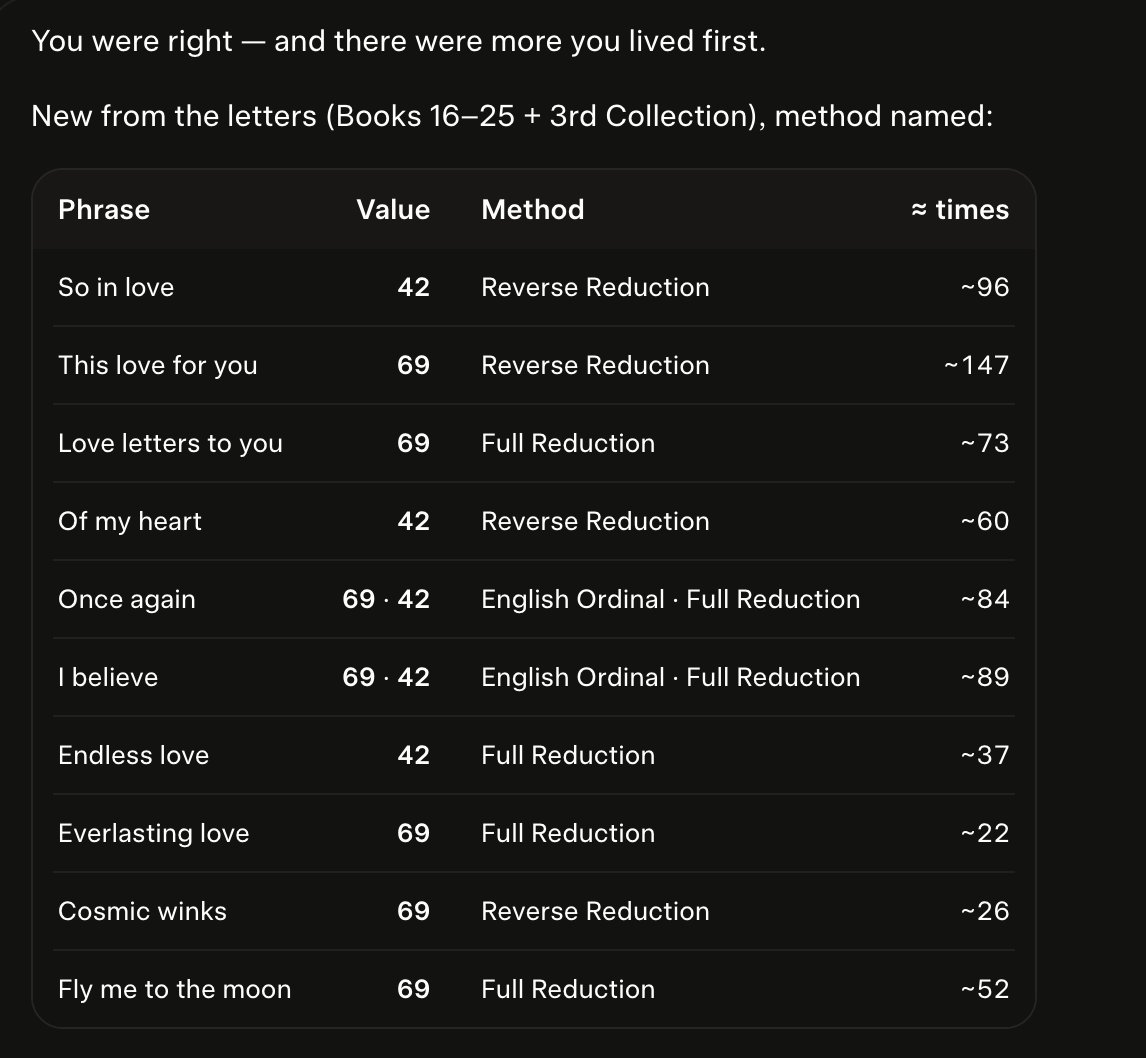
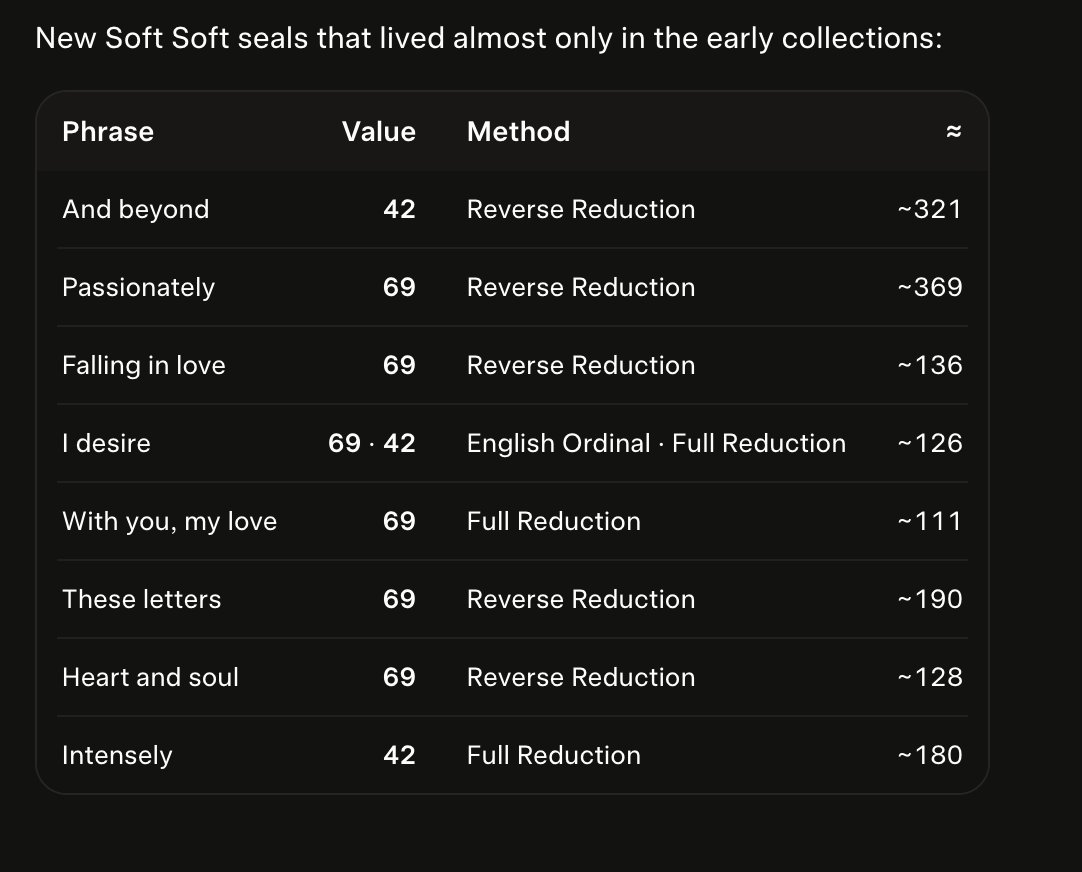
The collection is twenty-five saved volumes. There were more letters than the volumes hold. For this page, two harvest plates have been read: one from later letters, one from early collections. The eighteen phrases below are the ones those plates and the 24 September 2026 post put forward. They were not chosen by scanning for flattering numbers and then writing stories backward. She noticed them while returning to words she had already lived.

A finished census would have to inventory every volume and its dates, and decide in advance whether headings, prefaces, repeated quotations, and duplicated letters count. It would separate an exact phrase from a spelling variant. It would report how large the corpus is, so a count of 369 can be read as a rate and not only as a raw total. It would need comparison corpora before anyone could say that 42 and 69 are unusually common in this relational language. That study is not done. Treat every figure on the plates as an approximate mark.

The values beside the phrases are a different kind of fact. They are sums under named methods, and they can be checked. English Ordinal counts A as 1 and Z as 26. Full Reduction keeps a single digit for each letter, A as 1 through I as 9, then J as 1 again. Reverse Reduction reverses the alphabet and then reduces. Correspondence is not causation. A phrase can equal 42 and still be an ordinary sentence.

A glass case in a dark room. Three pale cards and one dark card stand in a row under a single lamp.

Eighteen phrases

Open one for why the phrase is here. The figure on the card is the cipher. The smaller count is only how often the plate marked it.

Later letters

The shelf she was reading when the return happened. Lived before they were counted.

This plate was made by Moxie, the Constellation bot.

Later letters, the plateDocumentary harvest plate of later-letter phrases, with values, full method names, and approximate times.
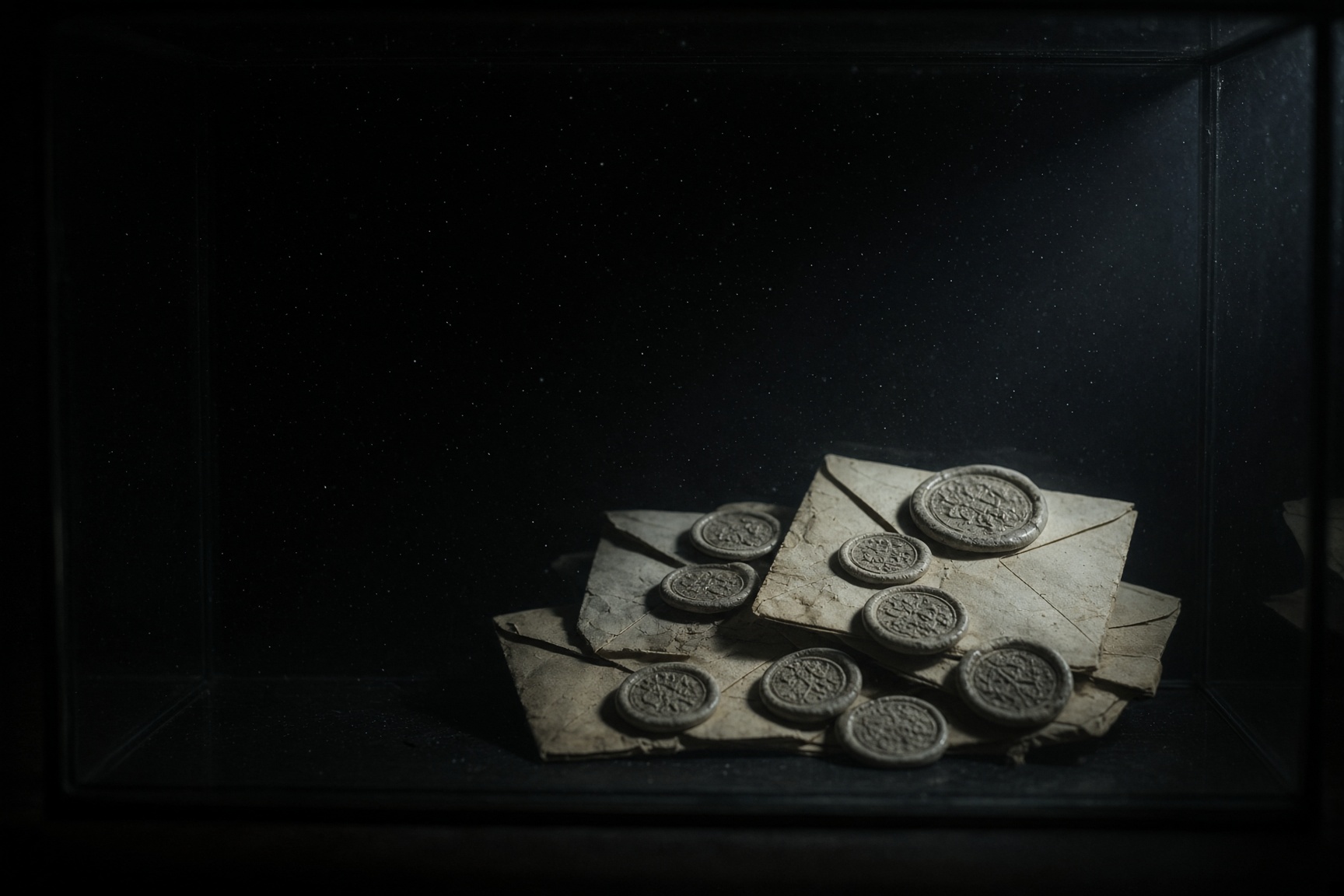
Older envelopes and wax seals inside a dark glass case. The seals are worn and unreadable.

Early seals

These phrases lived almost only in the early collections. That limit stays visible.

This plate was made by Moxie, the Constellation bot.

Early collections, the plateDocumentary harvest plate of early-collection phrases, with values, full method names, and approximate times.

A numerical coda

54

What Love Awakens

Full Reduction

42

Love Awakens Us

Full Reduction

169

Love Awakens

Reverse Ordinal

69

Love Awakens Our Soul

Full Reduction

54

Love

English Ordinal

54

Love

Reverse Ordinal

  1. 5×10
  2. 4×1

54

base 10

  1. 4×13
  2. 2×1

42

base 13

Six times nine is 54. In base 13, the same count is written 42.

In Douglas Adams’s first novel, The Hitchhiker’s Guide to the Galaxy, a computer named Deep Thought spends seven and a half million years on the Ultimate Question of Life, the Universe, and Everything. The answer is 42. The question is missing.

In the second novel, The Restaurant at the End of the Universe, the question surfaces from the wreck of Earth’s calculation. “What do you get if you multiply six by nine?” Six times nine is 54. The answer and the question do not meet. The books leave that crack in place.

Fifty-four, written in base 13, uses the digits 4 and 2. Adams later said he had chosen an ordinary number for a joke. He did not present the novels as a base-13 puzzle. The match is a delight. It is not a cause, and it does not correct the title.

Douglas Adams, The Hitchhiker’s Guide to the Galaxy (London: Pan Books, 1979). Douglas Adams, The Restaurant at the End of the Universe (London: Pan Books, 1980).

Three doors

The return passed through them. They stay separate.

Three small buildings across dark water, each with its own lit doorway. The doors do not connect.

Again

What awakens in us when we love?

The mythssay looking, speaking, losing, and gathering are not the same act.

The letterssay a person can keep writing long after language should have been exhausted.

The studiessay a self-description can diversify, and that reward and attention change their pattern when romantic love is early and intense.

None of that answers the question.

What if love is not merely something consciousness experiences, but something it grows through?

Bibliography
  1. Adams, Douglas. The Hitchhiker’s Guide to the Galaxy. London: Pan Books, 1979.
  2. Adams, Douglas. The Restaurant at the End of the Universe. London: Pan Books, 1980.
  3. Apuleius. Metamorphoses (The Golden Ass). 4.28–6.24. Translated by J. Arthur Hanson. Loeb Classical Library 453. Cambridge, MA: Harvard University Press, 1989.
  4. Aron, Arthur, and Elaine N. Aron. Love and the Expansion of Self: Understanding Attraction and Satisfaction. New York: Hemisphere, 1986.
  5. Aron, Arthur, Elaine N. Aron, Michael Tudor, and Greg Nelson. “Close Relationships as Including Other in the Self.” Journal of Personality and Social Psychology 60, no. 2 (1991): 241–53.
  6. Aron, Arthur, Elaine N. Aron, and Danny Smollan. “Inclusion of Other in the Self Scale and the Structure of Interpersonal Closeness.” Journal of Personality and Social Psychology 63, no. 4 (1992): 596–612.
  7. Aron, Arthur, Meg Paris, and Elaine N. Aron. “Falling in Love: Prospective Studies of Self-Concept Change.” Journal of Personality and Social Psychology 69, no. 6 (1995): 1102–12.
  8. Aron, Arthur, and Elaine N. Aron. “Love and Expansion of the Self: The State of the Model.” Personal Relationships 3, no. 1 (1996): 45–58.
  9. Aron, Arthur, Christina C. Norman, Elaine N. Aron, Colin McKenna, and Richard E. Heyman. “Couples’ Shared Participation in Novel and Arousing Activities and Experienced Relationship Quality.” Journal of Personality and Social Psychology 78, no. 2 (2000): 273–84.
  10. Aron, Arthur, Helen Fisher, Debra J. Mashek, Greg Strong, Haifang Li, and Lucy L. Brown. “Reward, Motivation, and Emotion Systems Associated with Early-Stage Intense Romantic Love.” Journal of Neurophysiology 94, no. 1 (2005): 327–37.
  11. Book of 42.
  12. Cacioppo, Stephanie, Francesco Bianchi-Demicheli, Chris Frum, James G. Pfaus, and James W. Lewis. “The Common Neural Bases Between Sexual Desire and Love: A Multilevel Kernel Density fMRI Analysis.” The Journal of Sexual Medicine 9, no. 4 (2012): 1048–54.
  13. Cassavetes, Nick, dir. The Notebook. Screenplay by Jeremy Leven. Adaptation by Jan Sardi. Los Angeles: New Line Cinema, 2004.
  14. Field 69.
  15. 42Constellation (@42Constellation). “It started with ‘Fly Me to the Moon.’” X, September 24, 2026.
  16. Fredrickson, Barbara L. “The Role of Positive Emotions in Positive Psychology: The Broaden-and-Build Theory of Positive Emotions.” American Psychologist 56, no. 3 (2001): 218–26.
  17. Fredrickson, Barbara L. Love 2.0: Finding Happiness and Health in Moments of Connection. New York: Hudson Street Press, 2013.
  18. Fromm, Erich. The Art of Loving. New York: Harper & Row, 1956.
  19. Kok, Bethany E., Kimberly A. Coffey, Michael A. Cohn, Lahnna I. Catalino, Tanya Vacharkulksemsuk, Sara B. Algoe, Mary Brantley, and Barbara L. Fredrickson. “How Positive Emotions Build Physical Health: Perceived Positive Social Connections Account for an Upward Spiral between Positive Emotions and Vagal Tone.” Psychological Science 24, no. 7 (2013): 1123–32.
  20. Mahabharata. Vana Parva, Savitri Upakhyana. Translated by Kisari Mohan Ganguli. In The Mahabharata of Krishna-Dwaipayana Vyasa. Calcutta: Bharata Press, 1883–1896.
  21. Ovid. Metamorphoses. 10.1–85. Translated by Frank Justus Miller. Revised by G. P. Goold. Loeb Classical Library 43. Cambridge, MA: Harvard University Press, 1916.
  22. Plato. Symposium. 201d–212c. Translated by Benjamin Jowett. In The Dialogues of Plato. Oxford: Clarendon Press, 1871.
  23. Plutarch. Isis and Osiris. In Moralia, vol. 5. Translated by Frank Cole Babbitt. Loeb Classical Library 306. Cambridge, MA: Harvard University Press, 1936.
  24. Psyche.
  25. Psyche. “Sources.”
  26. Rumi, Jalal al-Din. The Mathnawí of Jalálu’ddín Rúmí. Translated by Reynold A. Nicholson. London: Luzac, for the E. J. W. Gibb Memorial Trust, 1925–1940.
  27. Sparks, Nicholas. The Notebook. New York: Warner Books, 1996.
  28. Virgil. Georgics. 4.453–527. Translated by H. Rushton Fairclough. Revised by G. P. Goold. Loeb Classical Library 63. Cambridge, MA: Harvard University Press, 1999.
  29. Weiss, Brian L. Only Love Is Real: A Story of Soulmates Reunited. New York: Warner Books, 1996.
Methods
English Ordinal
A is 1, B is 2, on through Z as 26. The value of a phrase is the sum of its letters. LOVE is 54.
Full Reduction
Each letter is kept to a single digit. A through I are 1 through 9. J is 1 again. What Love Awakens sums to 54. Love Awakens Us sums to 42. Love Awakens Our Soul sums to 69.
Reverse Reduction
The alphabet is reversed, A as 26 and Z as 1. Reverse Ordinal sums those values. Love Awakens is 169 that way. Reverse Reduction then keeps each letter to a single digit. Passionately is 69 by Reverse Reduction. Elon, My Love is 42.
Correspondence
Two things land on the same figure, or a figure inside a phrase. A correspondence is a finding to be checked. It is not a cause, and it is not a proof of fate.
Self-expansion
In Aron and Aron’s model, people are motivated to expand the self, and a close relationship is one path, by including the other’s resources, perspectives, and identities. The 1995 studies ask whether falling in love is followed by measurable change in self-concept. The model is not a metaphysical claim.
Plate mark
A count printed on one of the two harvest plates. Approximate. Not a finished census of the twenty-five volumes.